
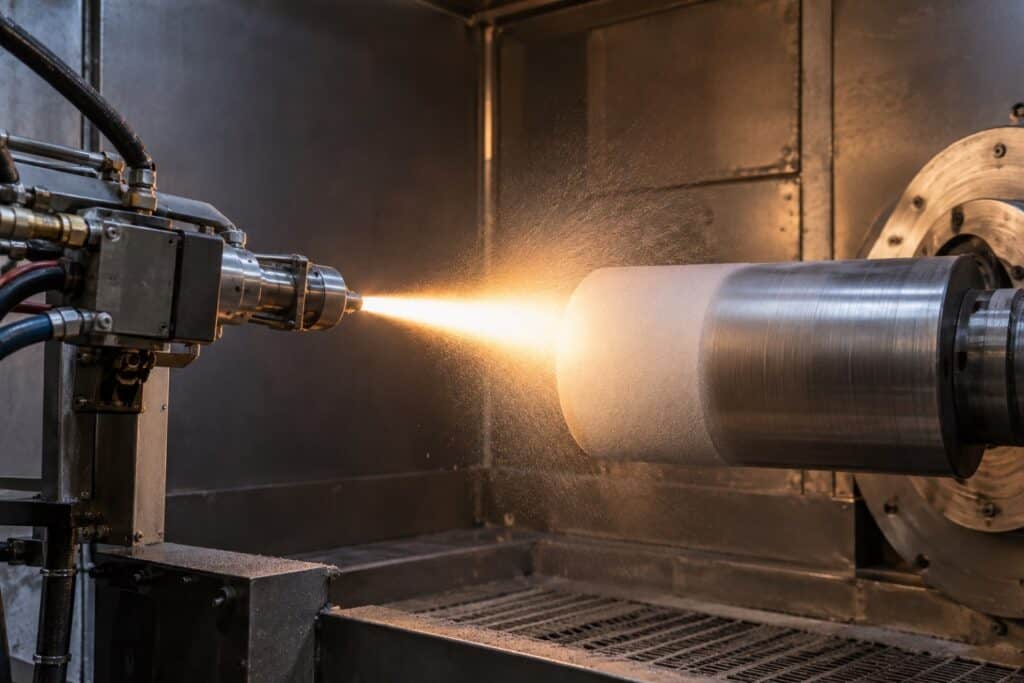
What is thermal spraying?
The surface engineering process of thermal spraying creates a surface layer of coating by spraying molten or semi-molten material at high velocity onto a prepared surface to improve wear resistance, corrosion protection, thermal insulation or electrical conductivity. Typical surface coating materials are metals, alloys, ceramics and cermets, which are mixtures of ceramic and metal.
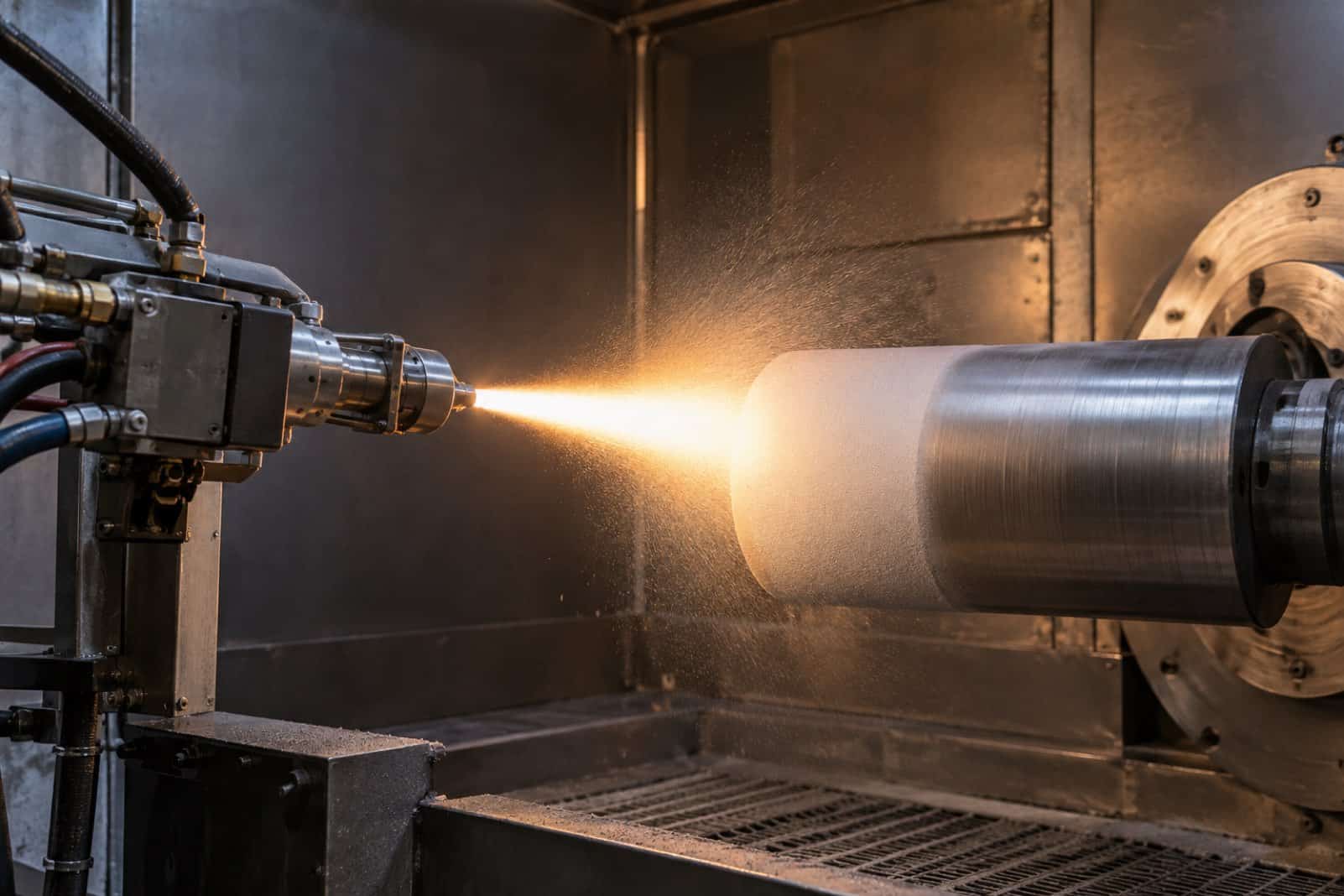
How the process works
Typically the material to be sprayed is supplied in the form of wire, powder or rod. The material is heated by a flame, or by an electric arc or by a plasma, until it melts or softens, and then propelled at high velocity by a stream of gas towards the part to be coated. Upon impact the droplets flatten, cool and on solidification bond together to form the coating layer by layer.
The surface of the part to be coated must be prepared before application. The surface is normally cleaned and grit blasted before coating to key the surface for coating adhesion. The quality of the finished coating is dependent on controlling 3 key factors: temperature, particle velocity and spray distance. Because the surface of the part coated with a thermal spray process remains relatively cool, distortion of the part is limited and many materials can be coated with a thermal spraying process.
Techniques
There are various methods of thermal spraying, including flame spraying, arc spraying, plasma spraying, high velocity oxy-fuel spraying and cold spraying. They differ in how hot and how fast the particles travel, which affects the coatings they can produce.
| Method | Heat source | Typical use |
|---|---|---|
| Flame spraying | Combustion flame | Simple, low-cost coatings and repairs |
| Arc spraying | Electric arc between two wires | Zinc and aluminium corrosion protection on large structures |
| Plasma spraying | Plasma jet | Ceramics and high-melting-point materials |
| HVOF | High-velocity combustion | Dense, hard carbide coatings for wear |
| Cold spraying | Heated gas, particles stay solid | Metals sensitive to heat or oxidation |
Applications and advantages
Thermal spray coatings are widely used in aerospace, oil and gas, automotive, power generation and general engineering. Typical jobs include protecting steel structures from corrosion, adding wear resistance to pump and valve parts, insulating hot components and rebuilding worn shafts. Companies such as https://www.poeton.co.uk/surface-treatments/thermal-metal-sprays specialise in providing thermal spray coatings for diverse industrial needs.
- A very wide range of coating materials.
- Thick coatings are possible, unlike most plating processes.
- Worn parts can be rebuilt and returned to service.
- Little heat reaches the part, reducing distortion.
- Large components can often be coated on site.
Limitations to be aware of
Thermal spray processes are line-of-sight so penetration into deep holes or other hidden areas is generally difficult. Some thermal spray materials contain small pores which may need to be sealed in order to afford adequate corrosion resistance. Most thermal spray coatings bond to a surface through mechanical interlocking rather than through a chemical reaction, so preparation and process control are critical.
Frequently asked questions
How thick can a thermal spray coating be?
It depends on material and process, but in general thermal spray coatings are often much thicker than corresponding layers produced by plating processes. This makes them well suited to rebuilding worn parts, and the coating is often machined or ground to the final size after being sprayed slightly oversize.
Is cold spraying really a thermal spray process?
It is usually associated with thermal spraying, but in contrast to it no melting of the particles takes place. Instead the particles are accelerated to very high speeds and bond on impact. This process is suitable for materials which could be damaged by heat or oxidation.
Where to go next
To see these coatings at work on vehicles, read how thermal spraying is used in the automotive industry.
By choosing the right spray technique and material combination, thermal spray coatings can deliver reliable performance in demanding environments.
